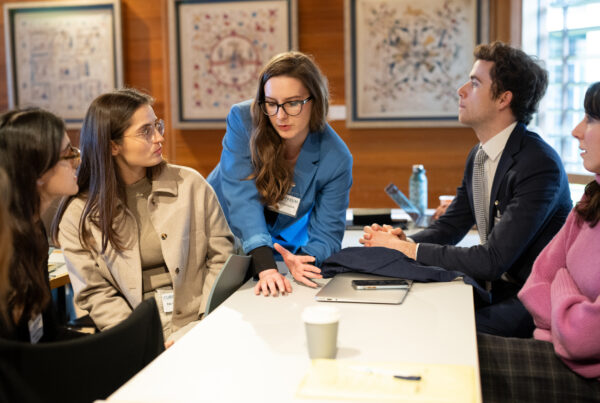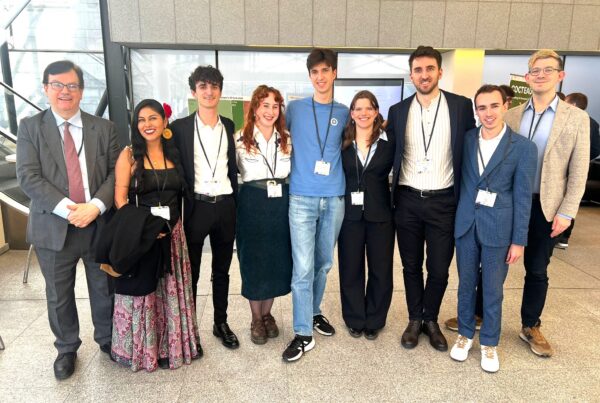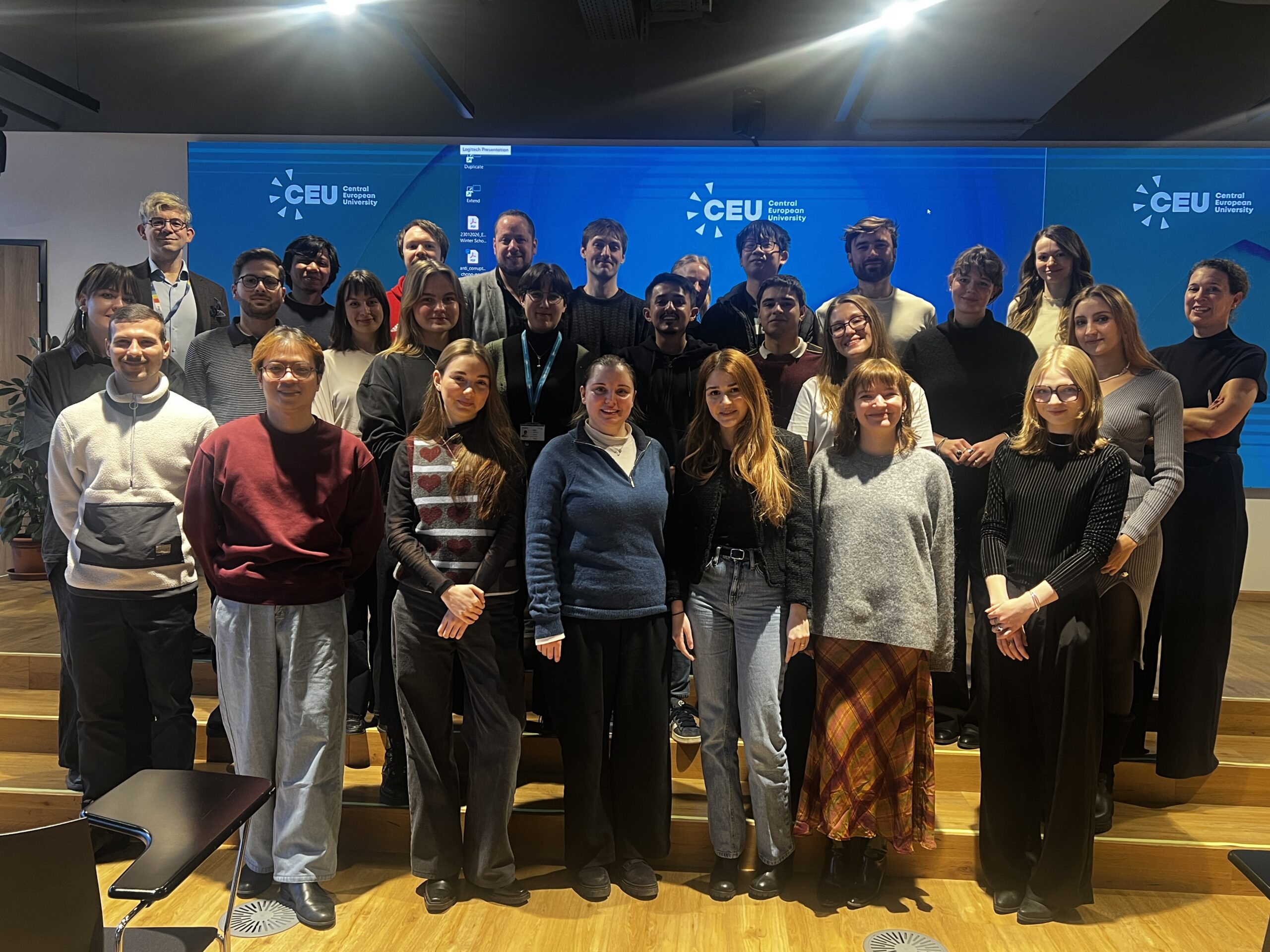
The 2026 Europaeum Winter School took place from 27–29 January at the Central European University in Vienna. The theme was ‘Scandal & Corruption’ two ideas which have long served as defining forces in politics, finance, and history.
Students were welcomed to the CEU by Prof. Dr Evelyne Hübscher from the Department of Public Policy, who served as the university’s lead contact for the event. Proceedings then got underway with a round table involving Prof. Mathias Möschel (CEU), Prof. Dr Laurenz Ennzer-Jedenastik (Uni Vienna), Irene Tello Arista (CEU), and the Core Director. The remainder of the first day saw a series of panels involving student presentations and faculty contributions from Dr Leonardo Carella (Uni Vienna) and Dr Zsuzsanna Szelenyi (CEU Democracy Institute). The second day saw the first keynote in which Dr Peter Kreko (CEU Democracy Institute) discussed ‘How information can be corrupted- Mass persuasion and informational autocratization in Europe and Hungary’. A further panel witnessed contributions from students, Mag. Stefan Melichar (an Austrian journalist working for Profil) and Mag. Bettina Knötzl (a representative of Transparency International).
The School’s final day saw another keynote from Prof. Dr Mihaly Fazekas (CEU), ‘Making the invisible visible: Surprising insights emerging once corruption is measured more accurately’, and further student/faculty mixed panels. Dr George Severs (Geneva Graduate Institute) discussed the issue of scandal in relation to Britain’s response to the AIDS crisis, Prof. David Nash (Oxford) the role of ‘shame’ as a tool of politics and policy, and Prof. Tommaso Soave (CEU) the micro-practices of legality in international tribunals. During the second afternoon the students made a visit to Vienna’s Crime Museum.
The Europaeum once again thanks all the Winter School’s speakers and the support staff at CEU, in particular Ingy Kassem, for their assistance and contributions.
Student Esther Zitterl (St Andrews) writes:
In an academic world that increasingly pushes PhD candidates towards hyper-specialisation, the Europaeum Winter School offered something rare: a space where radically different methodologies could meet around shared questions. Our focus on “Scandal and Corruption” brought together, among others, quantitative mappings of government violence against voter turnout in Italy, statistical analyses of football coverage displacing femicide reporting in Turkey, and my own Foucauldian reading of narratives surrounding the Windrush affair in Britain – all productively disorienting one another. The Winter School wove together a unique blend of universities, disciplines, languages, and backgrounds; and for my own research, offered a reminder that literary analysis gains sharpness when held against other ways of knowing. If that’s not a beautiful expression of what it means to be European, I don’t know what is.
Student Winona Kamphausen (Luxembourg) writes:
The Europaeum Winter School on Scandal & Corruption offered a unique opportunity to explore how issues of trust, transparency, corruption and institutional accountability are understood across disciplines. While my PhD doesn’t directly interact with these concepts, I found it inspiring to see how much thoughtful work is already being done and how hopeful the outlook can be. The exchange with other participants, each bringing different academic perspectives, broadened my thinking and reminded me of the value of an open, interdisciplinary mindset. I am grateful to the organisers for an engaging and insightful programme.
28 students from 9 Europaeum universities participated in the event.