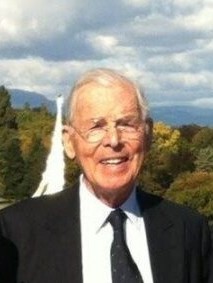
Dr Pierre Keller
(31 May 1927 – 23 February 2026)
Dr Pierre Keller, who died earlier this year, was the founding Chair of the Europaeum, and could not have been better suited to the role. He was financially and politically astute, an excellent reader of people, and possessed of an unusual ability to combine great courtesy with a steadfastness of conviction. He also gave generously and, above all, believed passionately in the project.
Pierre was the last of five children — the earlier ones being born in Zurich were brought up speaking German. Pierre, although also born in Zurich, was always stronger in French. On his father’s side there were farmers and a grandfather who was the village schoolteacher, while his father, starting out as pastor in Geneva and then Zurich, rose to become a significant figure in the international ecumenical movement, including holding a professorship in theology at the University of Zurich. His mother’s side came from a family of Swiss German industrialists. His mother, Tina Keller-Jenny, had the distinction of undergoing psychotherapy directly from Carl Jung, later becoming a Jungian psychotherapist, and one of the earliest exponents of the virtues of movement and dance in therapy.
Pierre read Law at the University of Geneva before going to Cambridge — not for a degree, but to learn English — and from there, without returning to Switzerland, went on to study international relations at Yale, completing both a master’s and a doctoral degree. It was the time of the Korean War, and visa complications meant he had to stay longer than planned, so he worked for a bank in the United States for a period before joining the Federal Department of Foreign Affairs — the Swiss foreign office — in 1956 and being posted to Bern. Despite being naturally diplomatic in manner, he found the actual work of diplomacy rather boring, and in 1961 he joined two friends, Thierry Barbey and Yves Oltramare, who had just become partners at the Lombard Odier bank in Geneva. Pierre’s courtesy, professionalism and, above all, his knowledge of America and interest in everything transatlantic suited the bank well as it moved into institutional finance, and in 1970 he became a partner himself.
It was through banking that he met (Sir) Ronald (Ronnie) Grierson. Among other things, they were both advising HSH Prince Hans-Adam of Liechtenstein. Ronnie was also an exceptionally close friend of (Lord) George Weidenfeld, and the two of them were forever plotting some new venture. With the fall of the Berlin Wall and Europe enjoying a heyday of idealism, Ronnie put an idea to George, and together they took it to (Lord) Roy Jenkins — who had just moved from the presidency of the European Commission to the Chancellorship of the University of Oxford: the idea was a network of leading European universities, aimed at giving the young “a sense of Europe”.
The Europaeum, founded in 1992 by Oxford together with Leiden, Paris 1 Panthéon-Sorbonne and Bologna, was at first run as a department of the University of Oxford. But as more members joined, they — and George — wanted greater independence from Oxford, and in 2004 the Europaeum was established as a UK charity. Its three founding Trustees were George, Ronnie and Pierre, who soon invited other distinguished Europeans to join the Board, among them Lord Chris Patten (who had succeeded Jenkins as Chancellor of Oxford), Erhard Busek (Vice-Chancellor of Austria, 1991-95) and Karel Schwarzenberg (Minister of Foreign Affairs for the Czech Republic, 2007-09 & 2010-13), together with two Rectors drawn from the member universities.
Pierre was the natural choice as Chair; a role he held until Patten succeeded him in 2017. He was the perfect foil to George and Ronnie: while they bubbled with ideas — and, it must be said, were sometimes distracted by newer schemes — Pierre was an island of stability. His charm, his easy smile, his quiet voice and his good sense of what mattered kept the Board sufficiently focused for the Europaeum to grow with little hindrance from its own trustees, helped, when necessary, by end-of-year injections of cash from Pierre to balance the books.
It was, however, in 2016–17 that Pierre’s true qualities shone most brightly. George died in January 2016, and the disastrous Brexit vote followed that June. The Europaeum was already under financial pressure: inflation was eroding subscription income, and the ever-resourceful Director-General, Paul Flather, was having to run events with almost no staff or funding. With some loss of members and with Paul’s unavoidable economies coming to a head at the same time as Brexit, these events might have been the end for the Europaeum. Instead, Pierre gave both strong moral backing and crucial financial underpinning to a plan to launch the new Europaeum Scholars’ Programme. At the crunch Board meeting in September 2017, I well recall his words: “The aircraft is on the runway with its engines running. I am sure we should say that it is cleared for take-off.”
At that same meeting, Pierre also showed his own gentle, mischievous and perceptive humour. The meeting was nearly over, but everyone knew not only that the Board was about to thank Pierre, but also that, before this, he would say a few words about Paul, since it was also Paul’s last meeting. Unexpectedly, Pierre turned to Paul and said, “I have one final question about the accounts.” Paul was scrupulously honest about money, but the colour drained from his face — Pierre knew perfectly well that accountancy was hardly Paul’s first love. Pierre continued: “It is about the number near the bottom of page three. The number is 1.” Paul looked yet more worried. Pierre paused. We were all watching, wondering. Finally he continued: “This 1 is you! You alone have kept the Europaeum afloat. I congratulate you and thank you.” Laughter all round.
Pierre’s contribution to the Europaeum did not end when he passed the Chair to Chris Patten in 2017. He had always been passionate about transatlantic relations and had readily supported activities devoted to discussing them. The state of the USA under Trump was therefore constantly on his mind. This came to a head in the summer of 2024, when Trump threatened to prevent international students, especially those at Harvard, from returning to the United States to continue their studies. Although Pierre was by then 97, we had an animated discussion lasting more than two hours about what the Europaeum might do. The outcome was that, backed by financial underpinning from Pierre, I wrote to the President of Harvard offering what help we could. Trump’s unconstitutional moves were struck down by the courts, so our offer was never called upon — but it was Pierre who made sure it was there.
A final story reached me just months before he died. Late in his life, his family discovered that he was having regular sessions with a priest. He was a religious man, but until this point he had regarded his beliefs as strictly personal and private. With their curiosity stirred, one member of the family asked the priest how the meetings were going — were they discussing the afterlife, or something of that kind? “Not at all,” came the swift reply. “We are discussing Transatlantic Relations!”
It was my enormous pleasure to work with Pierre for more than a decade. He was always well dressed, well-spoken and well informed. But it was far more than this: he became a good and warm friend. Beyond the friendship, I remember him especially as a man of immensely good judgment and wise counsel. His advice was always given with such courtesy that those who did not know him well could easily underestimate the firmness of his convictions and the clarity of his thought.
I carry — and will carry for the rest of my life — many memories of him. Of these, the ones that shine most brightly are the generosity of his smile, his ever-alert face, and the light in his eyes: often amused and teasing but interspersed with moments of real seriousness. He watched the world, the world interested him, and he cared for the world.
We miss him for his wisdom, his gentleness, and his strength. The words chosen for the cover page of the order of service for his funeral say it all:
“fortiter in re, suaviter in modo”
Dr Andrew Graham
(Chair of the Trustees of the Europaeum)