Sarah Vella, a PhD student researching macroprudential policies and credit misallocation at the University of St Andrews, reflects on the recent Europaeum Policy Seminar in Brussels.
Arriving with an economist’s perspective
At the end of September, I travelled to Brussels for the Europaeum Policy Seminar, “Europe under Pressure: EU Governance and the Politics of Uncertainty.” Over three days, from 29th September to 1st October, we visited various European institutions and met policymakers, researchers and journalists working on some of the challenges facing Europe.
My background is in economics and my doctoral research focuses on financial regulation and cross-border banking. I was therefore particularly interested in the economic discussions, but I also wanted to understand more about how European policy takes shape. The programme gave me the chance to step away from my usual research routine and explore those questions with professionals from very different fields.
Bringing Europe closer to its citizens
The first day opened with discussions on the pressures facing Europe and possible ways of responding to them. It was a useful introduction to the themes we would return to throughout the visit: cooperation, uncertainty and the difficulty of balancing different priorities such as trade and war conflicts, military and defence concerns and EU enlargement.
In the afternoon, we visited the European Parliament for a session on “Europe: getting closer to the citizens”. We learned about the European Parliamentary Research Service, the use of Eurobarometer surveys and the challenges of communicating the EU’s work to the public.
The discussion of public opinion particularly caught my attention. Working with data, I am used to thinking about what we can measure and what conclusions we can draw. Here, I found myself thinking more about what happens afterwards. Hence, how findings are explained, whose concerns they capture and how they inform decisions.
The visit to the hemicycle was another highlight. Seeing the chamber in person gave a sense of scale to the process of bringing together representatives from across Europe. Coming from Malta, I was interested in thinking about how smaller member states contribute to those discussions and how their priorities fit within the wider European agenda.
Seeing policy from different angles
On the second day, we visited the European Commission and the Committee of the Regions. Moving between institutions helped me understand their different roles more clearly. It also showed how many perspectives need to be considered before a European policy reaches the people affected by it.
The Committee of the Regions brought the local dimension into the discussion. Policies agreed at European level have consequences for particular cities, regions and communities, each with its own circumstances. This was a useful point to keep in mind as we moved through a programme largely focused on Europe-wide challenges.
Later that afternoon, we met colleagues at Bruegel to discuss strategic autonomy, energy and economic pressures. This was especially close to my interests. My research looks at how financial regulation affects behaviour across borders, so I appreciated the opportunity to place those questions within a wider discussion of economic interdependence.
It was also refreshing to hear these issues discussed outside a narrowly academic setting. The conversation encouraged me to think about how research can contribute to decisions made under uncertainty, when policymakers have to weigh competing objectives.
Who explains Europe?
Our final day included a visit to the European Economic and Social Committee, followed by journalists’ and experts’ panels at the Brussels Press Club. The journalists’ panel added a different perspective to the institutional visits. Throughout the seminar, we had been learning about how European policy is developed. This session brought attention to how that work reaches a wider audience and how journalists make complex developments understandable.
It made me reflect on communication in my own field. Economic research often involves technical language and qualifications that are necessary for accuracy but can make the main message difficult to follow. Explaining a finding clearly takes care, particularly when the subject affects people’s lives and attracts strong opinions.
The people between the sessions
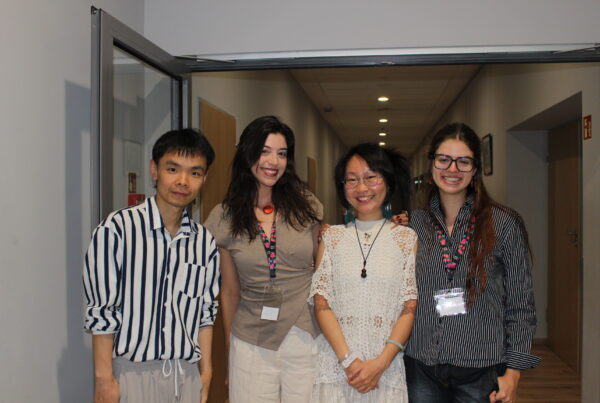
One of the pleasures of the seminar was meeting the other participants. Our group included students working in economics, politics, law, environmental sciences and several other disciplines. We shared an interest in European affairs, but we often started from quite different questions.
The meals and breaks gave us time to get to know one another beyond our university affiliations and research topics. They also allowed the discussions to continue at a more relaxed pace. I enjoyed being able to hear how others understood an issue before returning to it from my own perspective.
For someone whose day-to-day work can involve long stretches with data and academic papers, those exchanges were a welcome part of the trip.
What I took home
The three days were busy and the programme covered a great deal of interesting discussions. What stayed with me was the opportunity to connect the work of European institutions with the people involved in it and to discuss that work with fellow students from across the Europaeum network.
I returned with a better understanding of the institutional setting around the economic questions I study. I learned a great deal, both through the programme and through conversations with others. These experiences have indeed contributed to my development as a researcher and as a person. Spending time outside my own discipline encouraged me to consider different perspectives and approach familiar questions with greater curiosity.
Brussels gave me space to listen, ask questions and think about my research in a wider context. The visit left a lasting impression, broadening my outlook in ways that I will carry into my research and future experiences.